
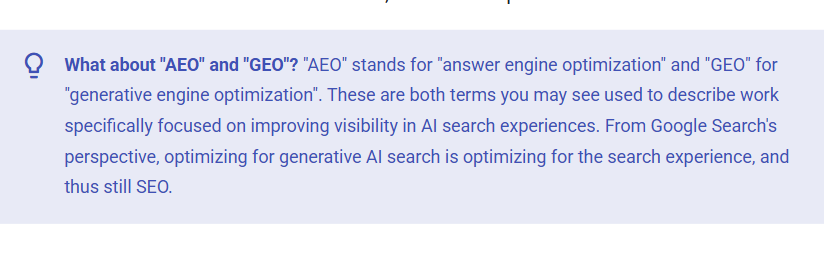
Google has finally come out and said what the majority of the respected, established SEO community has been saying for a while now. ‘Optimizing for generative AI search is optimizing for the search experience, and thus still SEO’. And that’s a direct quote from their AI optimisation guidelines.
So you can finally officially ignore all those posts you’ve seen about how you need a new approach to being visible online. All those scaremongering emails you’ve had about GEO/AEO/AIO can go in the bin. And the webinars you’ve wondered if you should have attended so you know what you need to do so you’re not left behind? They weren’t necessary after all anyway.
Working with SEO best practices is still key
SEOs who know what they are doing have been repeatedly pointing out that half the ‘new’ techniques for appearing in searches are, at best, just basic, good-old-fashioned SEO best practice rebranded. And that, more worryingly, a lot of the new ‘advice’ is at best useless and at worst has the potential to seriously harm, even destroy your visibility.
Google officially confirming that best-practice SEO is still at the heart of everything should help dispel some of the fear. No one is pretending nothing’s changed. Everything evolves, just as it always has. And just as they always have, SEOs will adapt accordingly.
What did Google actually say about generative-AI-search optimisation?
Google makes the point that ‘generative AI features on Google Search are rooted in core Search ranking and quality systems’. They use retrieval-augmented generation (RAG), also known as grounding, in their AI responses. Query fan-out then fetches relevant, related further information.
A lot of the so-called GEO/AEO/AIO techniques go back to the ‘black-hat’, let’s-see-how-we-can-game-the-system style of optimisation. They ignore the end user and how useful what they get is going to be to them. They also ignore that, as the search engines and AI evolve, they’ll be penalised by them – if they haven’t been already. Also, as searchers/potential customers/longstanding clients find nothing of value, they’ll erode their authority, trustworthiness, and relevance.
The ‘GEO hacks’ you can ignore
Google says: ‘While terms like Answer Engine Optimization (AEO) or Generative Engine Optimization (GEO) are common online, many suggested “hacks” aren’t effective or supported by how Google Search actually works.’ These are the things they say you can ignore:
- LLMS.txt files and other ‘special’ markup – you don’t need to do anything new or different or to create new machine readable files to appear in Google’s generative AI searches.
- ‘Chunking’ content – Google systems understand multiple topics on a page and will show the relevant bits to users. There’s no need to ‘chunk’ it, or break it down into sections. As before, concentrate on making pages for your audience, not search.
- Rewriting content for AI systems – generative AI search understands general meanings so keywords and endless variations of the same thing are not necessary.
- Seeking inauthentic ‘mentions’ – generative AI still focuses on finding high-quality content and blocking spam.
- Overfocusing on structured data – structured data should be used as part of your overall SEO strategy but isn’t part of generative AI search.
Best practice and non-commodity content
For generative AI search, apply foundational SEO best practices. Google was very clear with this. If your website isn’t ranking on Google, there will be a reason. It could be mainly for technical reasons, or it could be due more to your content. Either way you’ll need to look at your SEO. And at the heart of the latest evolution of search is what Google’s calling non-commodity content.
Creating non-commodity content
As always, you should be producing content that offers EEAT – experience, expertise, authoritativeness, and trustworthiness. As AI can – and does – churn out reams of basic information, we should be getting away from content without added value. This either is, or could be, produced by AI. Google says:
- Offer a unique point of view – based on firsthand, in-depth experience
- Create content that’s helpful, reliable, and people-first – based on a unique, expert take and that’s not just common knowledge
- Write content for readers that’s easy to follow – use sections, paragraphs, structure, etc
- Add high quality images and video – that are relevant
- Focus on what your users want – not creating and optimising for every possible variation
- If you use generative AI tools – ensure your content meets the published standards
Essentially, and as Google sums it up:
‘You can simplify your approach by focusing on one core principle: focus on what your visitors would enjoy, find helpful, and feel satisfied with after visiting your website’.
Technical SEO for generative AI
Technical SEO often gets overlooked by business owners, usually because everything can ‘look’ fine, even when it’s not. Without clarity in structure and all the right signals and information that Google needs, a webpage will be overlooked for generative AI search, just as it will fail to rank. Google again stresses the importance of SEO best practices here. They mention:
- Meeting search technical requirements – obvious but can’t be overstated. Your page must be indexed and eligible to be shown in search
- Following crawling best practices – your content must be crawlable.
- Focusing on readability over semantic HTML – but use it where possible as it helps other users including screen readers.
- Following JavaScript SEO best practices – Google can process content that isn’t blocked.
- Providing a good page experience – make sure your site displays well across devices and that people can distinguish your main content from other elements.
- Reducing duplicate content – it gives a bad user experience and wastes search-engine crawling resources.
Consider exploring agentic experiences
Google suggests exploring agentic experiences as AI agents increasingly seek information to carry out tasks. For this they point businesses to their agent-friendly-website best-practices information.
What you should do for your business
To summarise:
- Apply SEO best practices to generative AI search
- Create non-commodity content that’s helpful, reliable, and people-first
- Prioritise effective SEO strategies over “AEO/GEO hacks” (Google’s use of inverted commas says it all)
- Explore agentic experiences
I have small-business and freelancer clients with ‘basic’ websites who regularly appear in AI searches – and get queries from them. And that’s not because we’ve done any special GEO/AEO/AIO work on them. It’s because we’ve got strong technical and on-page foundations based on SEO best practices and copy and content that complements it.
Please don’t get caught out by self-proclaimed GEO/AIO experts telling you you’re doing it all wrong or you need them to save you from obscurity. You don’t. You just need an SEO who knows what they’re doing. If you’d like to know how your website is positioned currently and want to increase your visibility the right way, get in touch.